
Note: This post contains affiliate links. If you click and make a purchase, I may receive a small commission at no additional cost to you.
Tennis lessons are great. Coaches are great. Hitting with a friend is great too (as long as they don’t “warm up” by blasting winners at your shoelaces).
Still, most improvement doesn’t happen during the lesson. It happens between lessons, when you’re trying to remember what your coach said while your brain whispers, “Let’s just push it in and survive.”
That’s the problem for a lot of beginners and intermediates. You don’t need more random rallies. You need smarter reps, because most of us don’t have time for three-hour hit sessions or the mythical 10,000-hour rule. Also, your elbow would like a word.
This is where the Topspin Pro can help. It’s a simple training tool that lets you practice the swing path and contact you want, on purpose, for a few minutes a day. Ten minutes, not ten years. And yes, you still have to get back on court and hit real balls, but this makes that part way less chaotic.
Why most players struggle to learn topspin from regular hitting
Topspin looks easy on YouTube. Then you try it, frame three balls, launch one into the next zip code, and decide that “nice safe push” is your new personality.
The main issue is simple: a moving ball is hard. Timing is hard. Spacing is hard. And when you’re even a little late, your body panics and picks the safest option, which is usually a stiff-arm poke.
That’s why practice can feel like it should be helping, yet your match forehand still disappears the second the score gets close. Under pressure, we don’t rise to our goals, we fall back to our habits. So if your habit is “just block it back,” that’s what shows up on break point.
Focused reps beat random reps, especially for busy players. A short, repeatable drill that trains the right motion can do more than an hour of casual hitting where you’re just hoping the ball behaves.
You cannot fix a moving contact point if you never repeat it
In a rally, the ball never arrives the same way twice. One comes low and slow, the next sits up high, then your partner accidentally hits a slice that dies at your feet. Your brain doesn’t get consistent input, so it can’t lock in the feel you’re chasing.
Topspin needs a reliable contact zone and a clear “brush” up the back of the ball. Yet most players spend practice reacting, not repeating. As a result, the misses feel random, even when they aren’t.
Here’s what that looks like in real life:
- Your forehand flies long when you try to “swing faster,” because the racket face stays too open.
- Your backhand floats short because you guide the ball instead of driving and brushing.
- High balls turn into shanks because you don’t trust your spacing, so you crowd the contact and jam yourself.
If you want the motion to stick, you need a setup where you can repeat the same contact point over and over, without the ball changing its mind mid-flight.
Most “practice” does not look like match shots
A lot of friendly baseline hitting turns into cooperative patty-cake. The ball speed drops, the targets get fuzzy, and both players fall into the “keep it going” trance. That can be relaxing, but it doesn’t train the swing you need when points matter.
In matches, you don’t get the same easy ball five times in a row. You get one decent look, your heart rate jumps, and you have to choose. Go crosscourt? Attack down the line? Add height? Hit with spin for safety?
When your practice is mostly slow, safe rallies, you don’t train two things that decide most recreational points:
Consistency with purpose (a repeatable swing that holds up) and decision-making (choosing the right shot, not the hero shot).
That’s why “I hit great in practice” is so common. Practice did not copy match conditions. Then the match exposes it like a bright flashlight in a dark room.
How the Topspin Pro helps you build better strokes faster
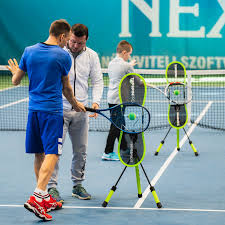
The Topspin Pro is a physical trainer that holds a ball in place so you can practice brushing up on it. The key word there is place. The contact zone doesn’t wander.
It’s not magic, and it’s not a substitute for real hitting. What it does well is help you build the fundamentals that make topspin easier: the low-to-high swing path, the feel of brushing contact, better spacing, and a balanced finish.
Because the ball sits in the same spot, you can stop guessing. You can work on one change at a time, then take that change back to the court.
It’s useful for both forehands and backhands. It can also support other shots indirectly. When you get comfortable accelerating up and through contact, you usually feel more confident with higher bouncing balls, heavy rally balls, and even the swing path on topspin serves. No wild promises here, it just helps your racket learn a better track.
It teaches the correct swing path, low to high, without guessing
Most topspin problems are swing-path problems. Players either swing too flat, or they chop down, or they “flip” their wrist and hope the ball behaves.
Topspin comes from brushing up the back of the ball while still driving forward. Think of it like rolling a tire forward while also lifting it a bit. You’re not scooping, and you’re not slapping.
With the Topspin Pro, the shape of the trainer encourages that low-to-high path. If you swing correctly, your racket travels up and over the ball in a way that feels smooth and repeatable.
This matters because topspin gives you two gifts at once:
- Margin over the net (you can hit higher and still bring the ball down)
- Control at pace (you can swing more freely without launching everything long)
Players often notice fewer balls dumped into the net because they stop “pushing” the ball forward. They also see fewer balls sailing long because the swing starts to add spin, not just speed.
It gives you instant feedback, so you stop repeating the wrong motion
In regular hitting, feedback can be slow and confusing. You miss, then you guess why. Was I late? Too close? Open face? Weird grip? Meanwhile, the next ball is already coming, so you “just hit it” and hope.
The Topspin Pro gives faster feedback because the ball is stable. When you brush it well, you can feel it. You often hear it too, that clean “thwip” sound instead of a clunky thud. When you get it wrong, it’s obvious, and you can fix it on the next rep.
That quick loop matters for newer players. It builds confidence because you’re not waiting 20 shots to stumble into one good contact. You’re rehearsing the good contact on purpose.
If you’ve ever left the court thinking, “I have no idea what I’m doing,” instant feedback is your new best friend.
A simple 10-minute a day plan to use between lessons
If you take lessons, this is where the Topspin Pro shines. Your coach gives you a change, then real life happens. Work, school, traffic, dinner, a sore shoulder, whatever.
A short daily routine keeps the change alive so you don’t show up to your next lesson back at square one. It’s the difference between “I kind of remember” and “I’ve done this 300 times.”
Keep it light. Smooth swings only. Don’t go max effort. If your wrist or elbow complains, stop and adjust. Tennis improvement is fun, but being able to play next week is even more fun.
The 10-minute routine (forehand, backhand, and footwork in one session)
Set a timer. When it beeps, you’re done. That’s the whole point.
Minute 0 to 2: Easy forehands
Start slow. Find your spacing. Focus on a relaxed grip and a clean finish.
Minute 2 to 4: “Crosscourt-style” forehands
Aim your swing path as if you’re rallying crosscourt. Stay balanced, finish high, and keep your head still through contact.
Minute 4 to 6: Easy backhands
Two-handed or one-handed, keep the same goal: brush up, contact out front, finish with control.
Minute 6 to 8: Alternating sides
One forehand, one backhand. Add a small split step between reps so your feet stay involved.
Minute 8 to 10: Challenge set
Try for 20 clean reps in a row with your best form. If you miss, restart. It’s annoying. It also works.
A few simple cues help most players:
- Early unit turn: shoulders turn before the swing starts.
- Contact out in front: don’t let the ball get beside you.
- Finish high: let the swing complete, don’t quit early.
- Stay balanced: if you’re falling back, your timing will suffer.
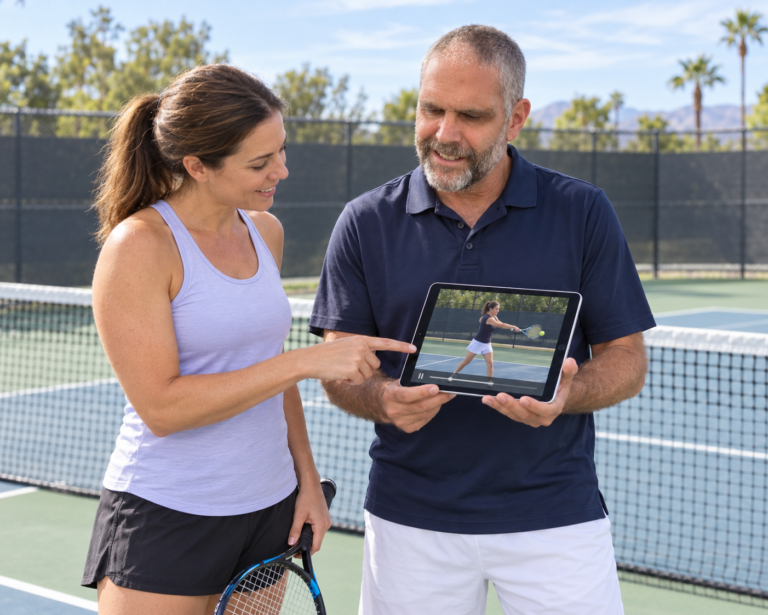
Once a week, record 20 seconds on your phone. Check posture and spacing. If you look like you’re hugging the ball, step back a bit.
How to know it is working when you get back on the court
The goal is transfer. You want the on-court ball to feel familiar, even though it’s moving now.
Here are signs you’re getting real carryover:
You clear the net with more height, yet the ball still drops in. You shank fewer balls because your spacing improves. Medium-paced rally balls stop feeling “awkward,” so your tempo stays steady. Short balls look less scary, because you trust your swing enough to go for them.
Also, your brain gets quieter. That’s underrated.
When you play points, keep the mental side simple. Use one swing thought only. For many players, “brush up” is enough. Then play. Don’t run a full technical checklist mid-rally unless you enjoy suffering.
If you want a between-point routine, keep it short: breathe, pick a target, pick a shape (higher and spinnier, or lower and firmer), then commit.
Who it helps most, common mistakes, and a soft next step
The Topspin Pro helps almost anyone learning topspin, but it’s especially useful for:
Beginners who keep framing balls and can’t find clean contact. Juniors who need reps without always needing a hitting partner. Adult improvers who want consistency but can’t practice for hours. Intermediates stuck in “push mode” who want a real swing they can trust in matches.
That said, any training tool can teach bad habits if you use it like a maniac. Smooth reps win. Tension loses.
Common mistakes to avoid so you do not build bad habits
A few quick errors show up a lot, and they’re easy to fix once you know what to watch for.
- Arming the ball instead of turning: Start with a shoulder turn, then let the arm follow. If your torso stays frozen, your arm does all the work.
- Hitting too flat: Make sure the racket travels up through contact. If your finish stays low, add more upward swing.
- Standing too close: Give yourself space. If your elbow feels pinned to your side, back up and reach out more.
- Snapping the wrist: Keep the wrist stable through contact. Let the forearm and shoulder create the path.
- Swinging too hard: Go at 60 to 70 percent. Clean contact beats wild speed every day.
- Leaning back: Keep your chest over your hips. If your weight drifts backward, your contact point usually drifts too.
If something starts to hurt, treat that as useful data, not a badge of honor. Adjust your grip pressure, slow down, and check your spacing.
My recommendation for coaching clients
For coaching clients, this is my favorite “between lessons” tool because it respects real schedules. Ten minutes a day is realistic. Ten minutes a day also adds up fast.
It pairs well with lessons because it locks in whatever you worked on, whether that’s topspin forehands, a steadier backhand, or simply learning to swing without fear. Then you show up to the next session ready for the next step, instead of re-learning the same fix.
If you want to grab one, use my affiliate link: Topspin Pro
After you get it, send your goal (forehand topspin, backhand consistency, or match confidence), and you’ll get a routine that fits what you’re working on now.
Conclusion
Random hitting feels productive, but focused reps change your game faster. The Topspin Pro helps because it gives you repeatable contact, clear feedback, and a reliable low-to-high swing path you can take back to the court. Add ten minutes a day, and progress stops being a mystery.
If you’re busy, that’s fine. Smart practice still works.
Questions about fitting it into your lesson goals, or getting topspin to show up in matches? Drop a comment. If you want the discount, here’s my affiliate link again: Topspin Pro