
Nobody loves the first time they watch themselves play tennis. You think you look like a pro out there, and then the video shows up on your phone and suddenly your forehand looks like you’re fighting off a bee. Good news: you’re onto something by filming at all. Most beginners never do. Bad news: filming yourself only gets you halfway there.
Here’s the catch nobody tells you. Video shows you everything, but as a beginner, you don’t yet know what you’re looking at. You’ll watch the clip, notice your racket looks “off” somewhere, and have no idea if the real issue is your grip, your takeback, your footwork, or your contact point. You end up staring at ten seconds of footage wondering what you’re even supposed to fix. That’s not a you problem. That’s just what happens before you’ve built the eye for it.
Video Tells You What Happened. A Coach Tells You Why
Say you film your forehand and it looks weak and floaty. On your own, you might guess it’s your grip. Maybe you try a different one for a week. Still floaty. Now you’re guessing again.
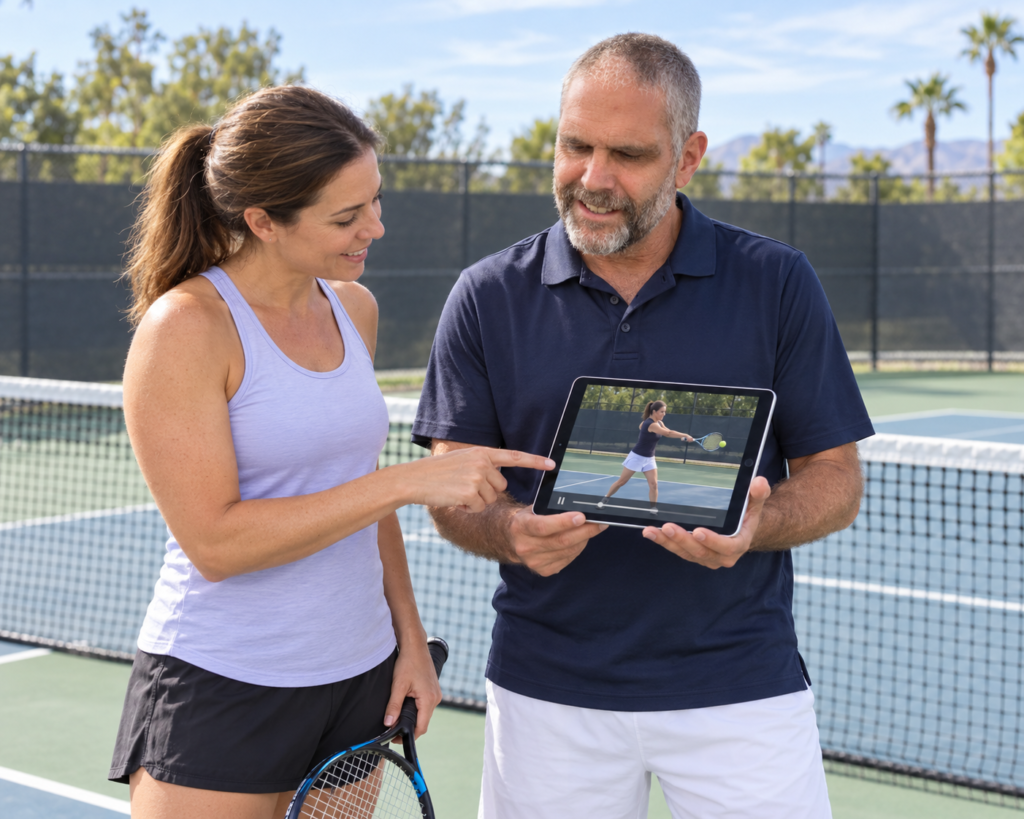
A coach watching that same ten seconds isn’t guessing. They can spot in one viewing that the real issue is your contact point is too far back, which is throwing off everything downstream, including the grip change you didn’t need. That’s the difference between video alone and video with a trained eye attached to it: one shows you the symptom, the other finds the actual cause.
This is exactly why lessons that include video review tend to move faster than lessons without it, and why video alone, without someone to interpret it, tends to stall out. You can watch your own swing a hundred times and still miss the one detail that’s actually holding you back, simply because you don’t yet know what “correct” is supposed to look like.
What Video-Based Coaching Actually Looks Like
When I work with a student, video isn’t a gimmick tacked onto the lesson. It’s part of the plan:
- We film during the lesson, so we can pause, rewind, and look at the exact moment something breaks down, instead of relying on memory of what just happened.
- I point to the one thing that matters most. Not five corrections at once. Beginners improve fastest when they’re rehearsing one clear change, not juggling a checklist.
- You get footage to take home, so between lessons you’re doing shadow reps or practice with a specific, correct picture in your head, not a guess.
- We compare new clips to old ones over time, so progress is something you can actually see, not something you’re hoping is happening.
Why This Matters More Early On
The habits you build in your first few months of tennis are the ones you’ll spend years either building on or trying to undo. A beginner rehearsing the wrong swing path with great confidence is more common than you’d think, and video without guidance can actually make that worse. You can film yourself doing the same mistake for months and never notice it, because you don’t know it’s a mistake. That’s the gap a coach closes.
Filming yourself is a great habit. Just don’t mistake having the footage for knowing what to do with it. If you want someone to actually watch it with you, point out what matters, and build a simple plan around it, that’s exactly what I do with students in Danville, Alamo, and San Ramon. Reach out and let’s set up your first lesson — it’s free, no pressure, no hard sell.