

Ever feel like tennis is a glitchy video game where the ball moves too fast, your feet move too slow, and your swing shows up two seconds late?
That’s where shadow stroking comes in. It’s simple: you practice your swings and footwork without a ball. No rally, no net drama, no partner watching you “invent” new errors in real time. Just you, a racquet (or even no racquet), and clean reps.
For beginners, it’s a cheat code in the best way. Less pressure, more control, and fewer bad habits sneaking in while you’re busy trying to just make contact. It’s also the definition of training smarter, quality reps beat mindless hitting every day of the week.
This post breaks down why it works, how to do it without grooving mistakes, and a 10-minute routine you can use at home.
Why shadow stroking works when regular hitting feels chaotic
A beginner rally is basically a fire drill. You’re tracking the ball, guessing the bounce, deciding forehand or backhand, then panicking and swinging anyway. The brain gets overloaded, and the body responds with the classics: stiff arms, late contact, ugly footwork, and that little hop after you hit (you know the one).
Shadow stroking removes the biggest source of chaos: the ball. That sounds too easy, but it’s the point. With no ball, you can build movement patterns that repeat. You can rehearse balance, spacing, and recovery, then bring those habits back to live hitting.
It also helps with decision-making, which sounds fancy until you realize it’s just picking a simple plan and sticking to it. When you shadow, you can visualize, “Crosscourt with margin,” or “Approach on the short ball,” without the scoreboard yelling at you.
And for adult beginners (and anyone whose knees complain after three wide balls), it’s joint-friendly. You can get better without beating yourself up. Staying healthy matters, because a shocking number of matches, especially in adult and senior tennis, come down to who can still move in set two. Sometimes “winning” is just still being upright.
Build better muscle memory by removing the ball
The ball is a distraction machine. Beginners chase it with their eyes, then chase it with their feet, then chase it with their swing, and everything gets rushed.
Shadow reps let you focus on one thing at a time:
- Grip and set-up
- Shoulder turn
- Swing path
- A full finish (not a panic poke)
Start slow. Make it clean. Then build speed.
A simple rule that saves a lot of frustration: if your form breaks, slow back down. Speed without control is just practicing mistakes faster.
Footwork and balance improve fast when you practice the “move, hit, recover” loop
Most beginners think tennis is about the swing. Then they play someone consistent and realize it’s about the feet (rude, but true).
Shadow stroking makes footwork the main job. Practice this loop until it feels automatic:
Split step, first step, set your base, swing, recover to ready.
When you do this a lot, two good things happen. You stop admiring your shots, and you stop getting stuck after you hit. That’s where rallies are won, not in the “perfect swing” fantasy.
How to shadow stroke the right way, so you do not practice mistakes
Shadow stroking is powerful, but it’s not magic. If you rehearse sloppy swings, you’ll build sloppy habits that show up right on time during matches (usually on break point, because tennis has a sense of humor).
The goal is quality over quantity. Think “clean reps” instead of “how many reps.” Ten good swings beat 100 rushed ones.
A simple step-by-step setup:
- Pick one stroke per mini-session (forehand, backhand, volley, or serve).
- Choose a target (crosscourt, down the line, middle). Yes, even without a ball.
- Shadow the footwork first, then add the swing.
- Reset to ready after every rep, like a metronome for your habits.
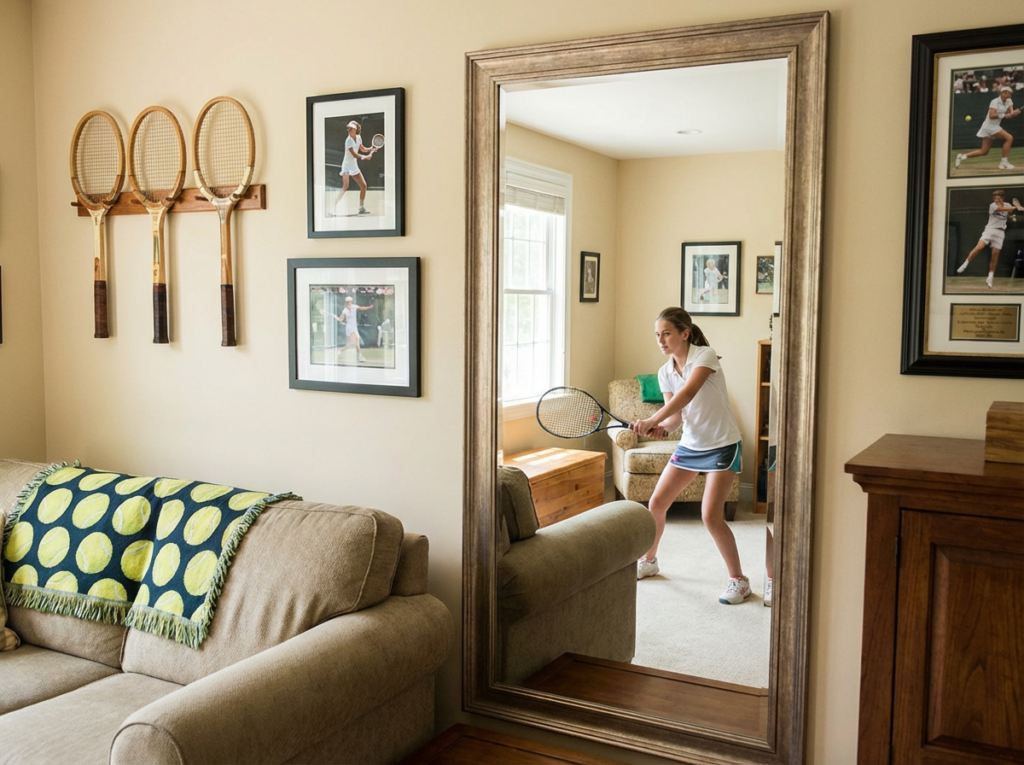
- Check yourself with a mirror or quick video, because your brain lies (kindly, but still).
This is also great “homework” between tennis lessons. You get coached once, then you rehearse the same movement all week, instead of forgetting it the moment you leave the court.
The simple checkpoints for forehand, backhand, volley, and serve
Use these as quick guardrails, not a 47-step checklist.
Forehand
- Turn shoulders early
- Racquet drops (don’t force it)
- Brush low-to-high
- Finish over the shoulder
- Reset to ready
Backhand (two-hand or one-hand basics still apply)
- Early turn (earlier than you think)
- Step to stabilize
- Swing through the target
- Balanced finish (no falling away)
- Reset to ready
Volley
- Small turn (not a backswing)
- Step forward
- Punch and hold the racquet face steady
- No big follow-through
- Reset to ready
Serve
- Consistent toss (in front, not behind your head)
- Trophy position (loaded, not rushed)
- Reach up (think “up,” not “hard”)
- Land inside the court
- Reset with a returner’s split step (so you practice what happens next)
One more safeguard: if something feels pinchy or sharp, stop. Shadow work should feel smooth, not like you’re negotiating with your rotator cuff.
Use a mirror or phone video to keep your form honest
Quick method, low effort, high payoff:
- 30 to 60 seconds per stroke in front of a mirror to check posture and spacing.
- Then film 10 reps from the side (your phone leaned on a water bottle works fine).
Look for a few simple things:
- Posture: are you tall and balanced, or hunched and reaching?
- Spacing: does your swing have room, or are you jammed?
- Finish and recovery: do you complete the swing and get back to ready?
Short home routines are popular because life is busy. The key is not just swinging, it’s checking that the swing is worth repeating.
A 10 minute shadow stroking routine beginners can do at home (plus how to level it up)
If you can scroll your phone for 10 minutes, you can do this routine. Do it most days, and you’ll feel more stable on court faster than you’d expect.
Keep it simple. Keep it smooth. And don’t chase “hard.” Chase “repeatable.”
The routine: slow reps first, then game speed reps
Minute 1: Split steps and side shuffles (stay light, quiet feet)
Minutes 2 to 3: Forehand
- 10 slow reps (clean form)
- 10 faster reps (same form)
Minutes 4 to 5: Backhand
- 10 slow reps
- 10 faster reps
Minutes 6 to 7: Alternate forehand and backhand with recovery
- Shadow: move, hit, recover, reset
Minute 8: Volley steps
- Two steps in, “punch,” recover
Minutes 9 to 10: Serve motion and first move
- Shadow 8 to 12 serves
- After each, do a small split step like you’re ready for the return
Stop if pain shows up. Smooth beats hard. Always.
Level up: add simple patterns and mental cues that show up in real matches
Once the routine feels easy, add a little “match flavor”:
- Crosscourt pattern: 3 reps crosscourt, 1 down the line
- Approach and volley: shadow a short ball, then close and volley
- Return plus one: split step, “return,” then your next shot
Add one between-point habit so your brain practices calm: Take a breath, pick a target, commit.
Match days get weird. Games run long, opponents grind, ratings don’t match what you see in front of you, and sometimes the win goes to the player who stays calm (and still moving) when things get messy. Shadow reps are a sneaky place to rehearse that calm.
Conclusion: cleaner technique, calmer tennis, and fewer “what was that?” swings
Shadow stroking builds better technique because it strips tennis down to the parts you can control: your feet, your swing path, your balance, and your reset. It’s low stress, low cost, and easy to do at home, which means you’ll actually do it (the most underrated training plan of all).
Start with 10 minutes. Film once a week. Bring one focus point to your next hit, like “finish and recover” or “early turn.”
Try the routine for 7 days and notice what changes. Odds are you’ll feel more stable on court, and your swing will stop feeling like a last-second guess. That’s a win you can repeat.

A really good blog and me back again.